



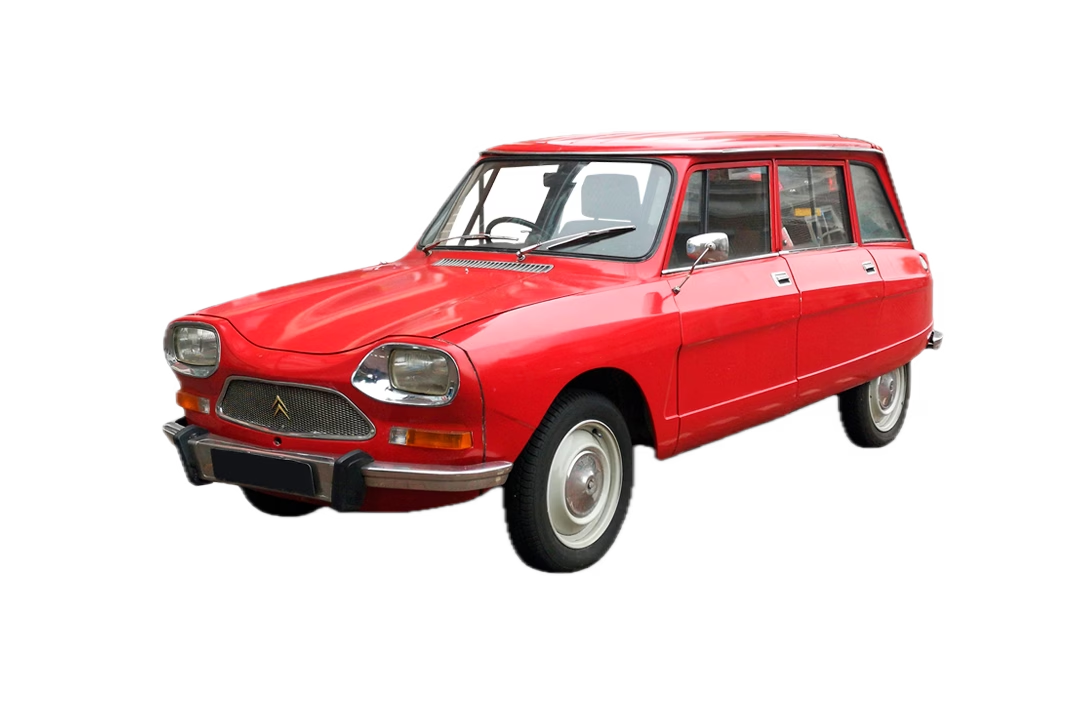


Choosing the right rear brake kit
The rear brakes remain drums even when your 2CV, Dyane or Méhari has front discs. The correct kit depends on fluid, cylinder and pipe connection.
Assess the front and rear brakes as one system
The front brakes help identify the hydraulic system. Front drums normally belong to a Lockheed/DOT 4 installation; the original front-disc configuration uses LHM. Rear wheel cylinders must suit the same fluid. Similar appearance or matching bolt spacing does not prove compatibility.

Identifying the versions
| Version | Approximate period | Main check |
|---|---|---|
| Early 2CV | Up to 1963 | Old 10 mm connection and matching cylinder |
| 2CV with front drums | 1963–1973 | Transition between old and 9 mm connections; compare the fitted part |
| 2CV with front drums | From 1973 | 8 mm Lockheed version |
| 2CV with front discs | From 07/1981 | 8 mm LHM version |
| Dyane 6 / Méhari with front discs | 07/1977–07/1978 | Early 10 mm LHM version; physically verify the thread |
| Dyane 6 / Méhari / Acadiane with front discs | From 08/1978 | 8 mm LHM version |
Transition data for early Dyane and Méhari versions are not entirely consistent. Use the actual cylinder and pipe as your reference. A table giving the diameter of the front drum does not determine the rear drum diameter.
Centring the brake shoes
Shoes may be installed with eccentric adjusters or concentric centring devices. Check which parts your kit includes and which adjustment procedure applies. The shoes must be centred on the drum; turning only the upper adjusters is not a substitute for correct centring.
What should be checked together?
- Diameter and condition of both rear drums.
- Cylinder bore, fluid type, pipe connection and bleed nipple.
- Width, shape and lining of the shoes.
- Springs, centring devices, anchor points and fittings.
- Leaks, seized pistons and contaminated linings.
Replace friction linings in axle sets and repair leaks before fitting new shoes. Correct adjustment, bleeding and a controlled brake test are necessary after assembly. This sheet helps select parts; it does not replace the installation procedure.
Send Citroparts the model, year and clear photographs of the fitted parts so we can help you choose. Contact us.
