



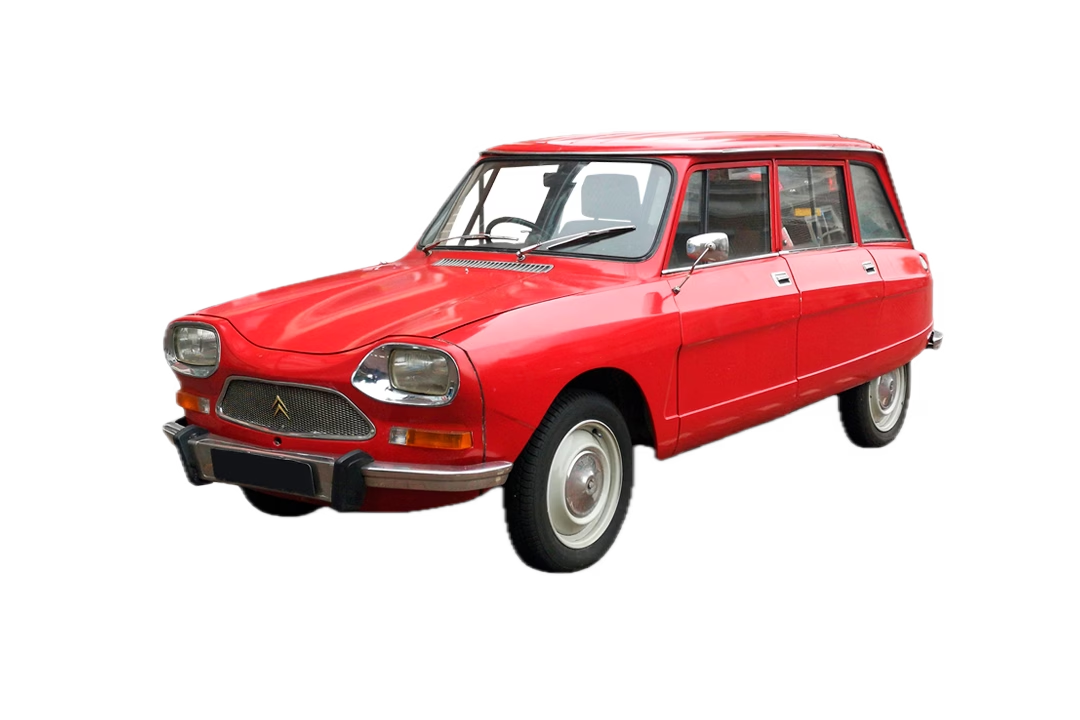


The development of 2CV ignition
Trace the development of 2CV contact breakers and coils, and distinguish original ignition equipment from later electronic replacements.
The wasted-spark principle
The flat-twin uses a coil with two high-voltage outputs. Both plugs fire together: one cylinder is at the end of compression and the other on the exhaust stroke. This is known as wasted-spark ignition. There is no conventional distributor cap.

From 6 to 12 volts
| Period | Electrical system | Ignition |
|---|---|---|
| From 1949 | Initially 6 V | Mechanical contact breakers |
| From 1965 | Some special versions already 12 V | Mechanical contact breakers |
| From February 1970 | 2CV 4 and 2CV 6 with 12 V | Mechanical contact breakers until production ended |
Special versions did not all change at the same time. Check the battery, charging system and coil fitted. An electronic module is a later replacement, not proof of factory electronic ignition.
Coil versions
| Period | Identification |
|---|---|
| 1949–07/1954 | Metal coil, often described as triangular |
| 07/1954–10/1960 | Rubber coil housing |
| From 11/1960 | Bakelite coil housing |
Electronic replacements
Electronic modules replace switching by contact breakers, eliminating contact wear and periodic adjustment. Depending on the module, advance is also controlled electronically. Matching voltage, engine curve and coil is therefore essential.
- Retain the correct historical version for an original restoration.
- When modernising, follow the instructions for the exact module.
- Compare primary coil resistance and specified plug leads.
- Check poor earths, cables and plugs before blaming ignition alone.
Send Citroparts the model, year and clear photographs of the fitted parts so we can help you choose. Contact us.
